Text
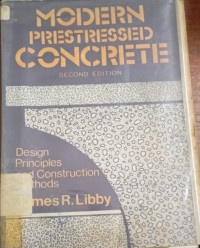
Modern Prestressed Concrete : Design Principles And Construction Methods
Subject topics: Principles of prestressed concrete Subject layout: Prestressing may be defined as the purposeful and controlled creation of permanent stresses in a structural member, before the full dead and live loads are applied, so as to counteract all or part of these loads. It serves two main purposes: to improve the resistance of the member to the dead and live loads (service load) and to modify the behavior of the member or structure in such a way as to make it more suitable for its intended purpose. There are significant differences in principle between reinforced concrete and prestressed concrete. In the design of reinforced concrete beams it is assumed that the tensile strength of the concrete is negligible, and the tensile forces created by the bending moments are resisted by reinforcement, to which the forces are transferred by bond. Cracking and, to a large extent, deflections are virtually irrecoverable in ordinary reinforced concrete, with relatively poor bond between the steel and concrete, though with high-strength concrete and good bond a substantial degree of recovery may take place. The reinforcement usually exerts no forces on the member on its own account. In prestressed concrete, on the other hand, the primary purpose of the prestressing steel is to apply a force to the concrete, either by bond or by means of special anchoring devices; hence the whole of the concrete can be made to act structurally. The steel required to produce the prestressing force is thus used actively to preload the member and cracking and deflections are recoverable to a higher degree. However, it should be noted that under overload conditions, as soon as the flexural tensile strength of the concrete has been exceeded, prestressed concrete behaves in a manner similar to reinforced concrete, and at the ultimate load or collapse condition of a flexural member, the tensile and compressive resistances required to withstand these conditions are the same for both reinforced and prestressed members. Moreover, as the prestress becomes zero, the behavior of a prestressed member becomes almost the same as that of a reinforced concrete member; thus, there are basic similarities, as well as basic differences, between reinforced and prestressed concrete. Based on the above articles, an open discussion and a wide range of researches plan could be carried out herein, … which is the main objective of the ONGoing project created in this platform.
Ketersediaan
Informasi Detail
- Judul Seri
-
-
- No. Panggil
-
624.1 LIB m
- Penerbit
- New York : Van Nostrand Reihhold Company., 1977
- Deskripsi Fisik
-
x, 629 hlm : ilus.; 20,5 x 15,5 cm; Biru
- Bahasa
-
English
- ISBN/ISSN
-
0-442-24781-8
- Klasifikasi
-
624.1
- Tipe Isi
-
-
- Tipe Media
-
-
- Tipe Pembawa
-
-
- Edisi
-
2
- Subjek
- Info Detail Spesifik
-
-
- Pernyataan Tanggungjawab
-
James R. Libby
Versi lain/terkait
Tidak tersedia versi lain
Lampiran Berkas
Komentar
Anda harus masuk sebelum memberikan komentar
 Karya Umum
  Filsafat
  Agama
Agama  Ilmu-ilmu Sosial
  Bahasa
  Ilmu-ilmu Murni
  Ilmu-ilmu Terapan
  Kesenian, Hiburan, dan Olahraga
  Kesusastraan
  Geografi dan Sejarah